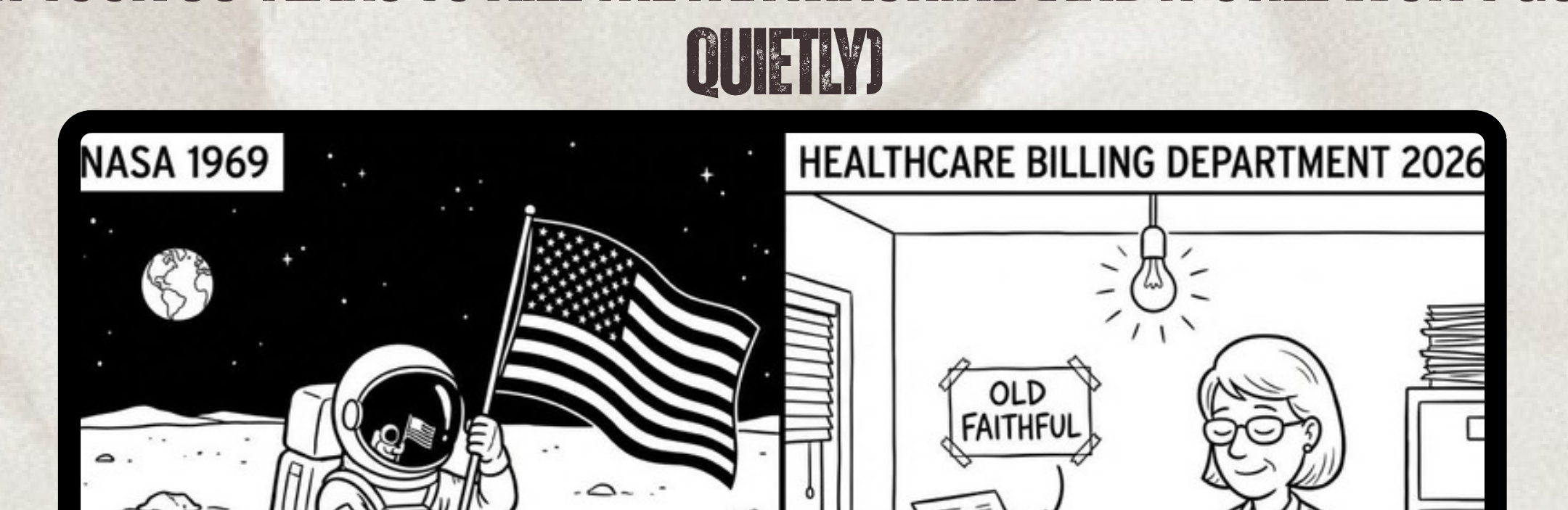
Let's take a moment to appreciate where we are as an industry. The United States federal government just had to pass a formal rule, with a compliance deadline, requiring healthcare providers to stop submitting medical records by fax.
In 2026.
It's been in the works since HIPAA was passed - which was in 1996. So to be clear: Congress identified the need to standardize electronic claims attachments thirty years ago. It has taken until now to finalize the rule.
Your fax machine has survived two recessions, a pandemic, and four presidential administrations. That thing has more job security than your DON.
Seven hundred and eighty one million dollars. That is how much the American healthcare system has been losing annually because it was using fax machines instead of the internet.
Most of that is staff and labor time. And most of that savings will be to the insurance companies.
For a typical SNF operator the savings will be real but modest - maybe a few hours a week of staff time across your billing and medical records team, fewer claim delays, faster adjudication.
It won't feel like $781 million. It'll feel like your billing coordinator stopped spending Tuesday afternoons at the fax machine. Btw 781 million is a lot. For context, that is more than the GDP of several small countries.
That is more than Welltower spends on acquisitions in a slow month. Shouldn't insurance companies use those savings to at least pause raising your premiums for like half a year? Asking for a friend.
The compliance deadline is May 2028 - 24 months from when the rule takes effect in May 2026.
Which means you have two years to implement electronic claims attachments, which is a generous timeline for something the rest of the business world figured out in approximately 2003. Almost makes you think the Gov doesn't have a high opinion of SNF owners.
In a truly impressive display of chutzpah however prior authorization is NOT included in this rule.
Prior authorization is where insurance companies make their money. The prior auth process - requiring providers to submit documentation before approving care - is the primary mechanism insurers use to delay, complicate, and ultimately deny claims.
It is also the process that generates the most administrative burden for providers and the most frustration for patients.
Standardizing electronic prior auth attachments would mean that when UnitedHealthcare asks you to submit 47 pages of clinical documentation to justify a skilled nursing stay, that process becomes fast, standardized, trackable, and auditable. The documentation goes in electronically.
The clock starts ticking. The denial or approval has to come back electronically on a documented timeline.
Right now the fax-based prior auth process is a feature, not a bug, for insurance companies. It creates friction. Friction leads to providers giving up on appeals.
Giving up on appeals saves insurance companies money.
Under a separate rule, payers are now required to send standard prior authorization decisions within 7 calendar days and expedited decisions within 72 hours CMS - but that only applies to the decision itself, not the attachment submission process that precedes it.
The attachment standardization would have closed a key remaining loophole: the part where you submit documentation and the insurer claims they never received it, or that it was in the wrong format, or that additional documentation is needed, and the whole process starts over.
Standardized electronic attachments with confirmed receipt and timestamps make that game much harder to play.