Look, we all know how this works.
The vendors set up their booths. The operators set up their defenses. And deals supposedly get done.
Do they? Sometimes. Maybe. It depends who you ask.
The organizers will tell you it's "the premier gathering of industry decision-makers." The vendors will tell you they're "excited to connect." The operators will tell you they're there for the "educational content" with a straight face, even though everyone saw them on the golf course during the CMS update session.
Let's talk about how the sausage gets made.
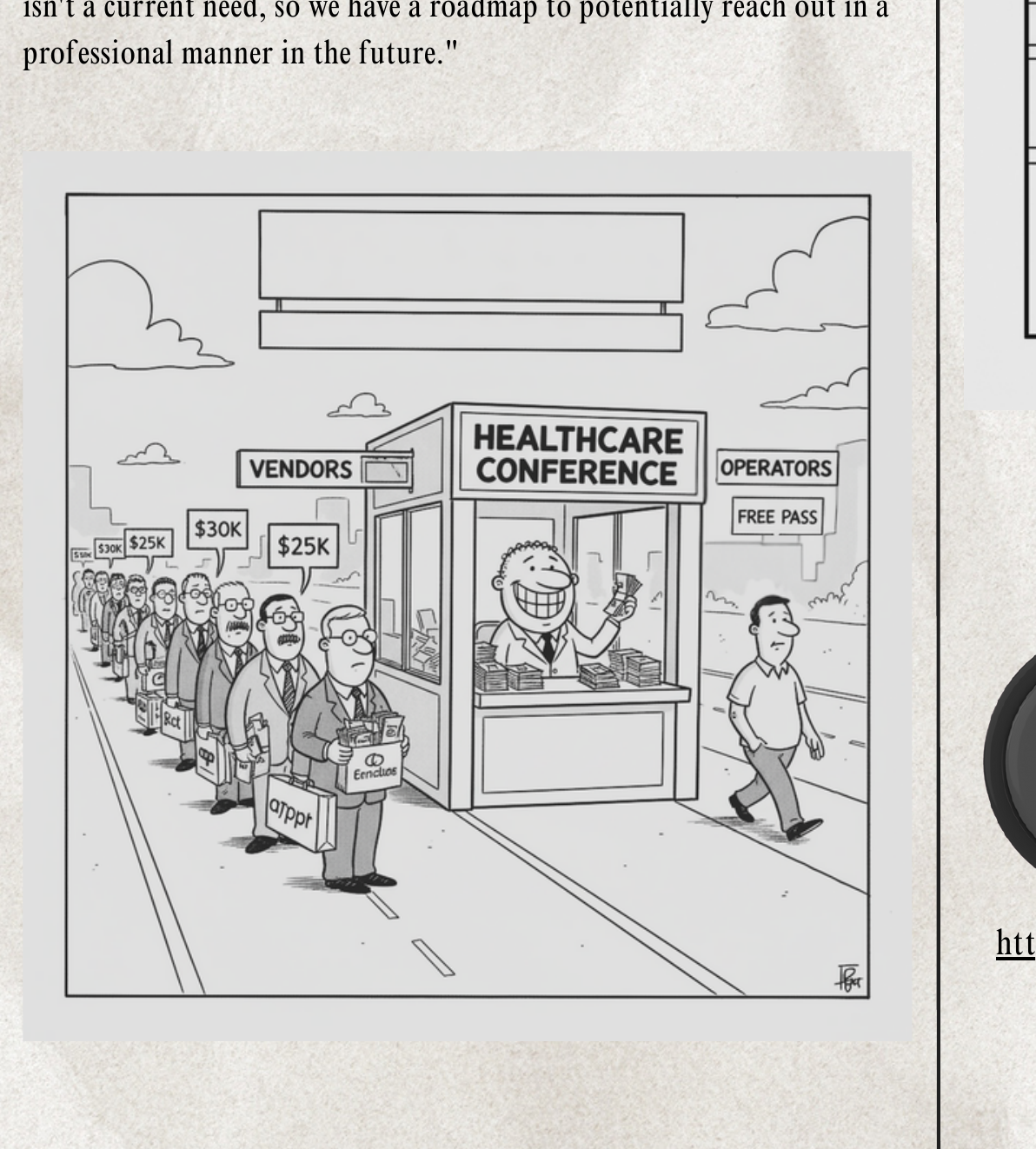
A conference, at its core, is a very simple business model: charge vendors $10,000-$25,000 for a booth and a dream. Charge operators $500 to show up (or nothing, if you really need them there). Put everyone in a room. Add an open bar. Do it somewhere nice. Call it "networking."
The vendors are paying for access. The operators are the access. And the organizers? They're the toll booth on the Garden State Parkway of healthcare schmoozing - collecting from everyone who wants to get through.
Nobody says this out loud, of course. The brochure talks about "educational sessions" and "industry insights" and "building meaningful relationships." And sure, sometimes that happens. But let's not pretend anyone flew to Miami in February because they were dying to hear a panel on PDPM optimization.
Bottom line:
The real conference happens in the margins. At the dinner table where you somehow ended up next to the guy who owns 40 buildings. In the lobby bar at 11pm when everyone's guard is down. On the golf course where a $200 round buys you four hours of uninterrupted face time with someone who won't return your emails.
That's where deals get done. Not at booth 47 between the wound care company and the pharmacy consultant.
The Vendor Experience
The vendor experience is its own special kind of purgatory.
You fly in the night before. You've got your banner, your brochures, your branded pens that cost way too much, and a bowl of candy that'll be empty by 10am.
And then you wait.
Operators walk by. Some make eye contact. Most don't. The ones who stop are usually administrators - nice people, salt of the earth, but they can't sign a check. The actual decision-makers are speed-walking to their pre-scheduled meetings, eyes locked on their phones, pretending they don't see you waving.
So you stand there. Smiling. For eight hours. Making small talk with other vendors. Handing out pens to people who will lose them by dinner. Wondering if the $15,000 you spent on this booth could've just been a discount for your next client.
By day two, you've developed a sixth sense for who's actually worth talking to. By day three, you've accepted that maybe two of the 47 conversations you had will turn into anything. By the flight home, you're already questioning whether you'll do this again next year.
(You will. Your competition will be there. You can't not be there. That's how they get you.)
The Operator Experience
The operator experience is different. Better, mostly. But not without its own headaches.
You show up and immediately the dynamic shifts. Vendors want your time. Organizers want your presence. Other operators want to know what you're buying, what you're selling, and whether the rumors about your building in Jersey are true.
You're the commodity here. And everyone knows it.
The first few hours are fine. You take meetings, catch up with people you actually like, maybe learn something useful. But by lunch, you're exhausted. Every handshake is a pitch.
Every "how's business?" is a prelude to a product demo. You can't eat a steak without someone sliding into the seat next to you to talk about their revolutionary new billing software.
So you develop strategies. You travel in packs. You pretend to be on important phone calls. You memorize the location of every side exit. You master the art of the polite brush-off: "Send me some information" (translation: please go away). "Let's connect after the conference" (translation: let's never speak again).
Some operators handle this gracefully. Others... don't. There's a certain type who treats vendors like peasants - won't give them two minutes, won't even pretend to be polite. Acts like their time is so valuable that basic human decency is a luxury they can't afford.
We've all seen it. Some of us have done it. It's not a good look.
Because here's what the big machers sometimes forget: that vendor standing at the booth, trying to get five minutes of your attention? He's got a mortgage. He's got kids in yeshiva. He's doing his hishtadlus just like you did when you were starting out. He's not trying to annoy you. He's trying to make a living.
Would it kill you to be a mensch about it?
Conference Politics
Then there's the conference politics. Because of course there are politics.
Some conferences are exclusive. You need to be invited. You need to know someone. You need to be the right kind of operator with the right kind of portfolio. If you're not in the club, you're not getting in.
Other conferences have the opposite problem - they'll let anyone in, which means the "decision-maker access" they promised vendors is actually "access to a bunch of regional administrators who came for the free CE credits."
And then there's the internal drama. The vendor who got kicked out because a competitor sat on the board. The operator who won't attend because someone poached his DON at last year's event. The whispered conversations about which conferences are "too frum" and which ones are "not frum enough" and what exactly happens at the after-parties that nobody wants to put in writing.
Everyone's got a story. Everyone's got a grievance. And everyone's going to show up next year anyway, because what's the alternative? Sit home while your competitors make connections? Miss the really fun MedElite sponsored Yankeloo performance?
FOMO is a powerful drug. Conference organizers know this. They're counting on it.
Why They Still Work
Here's the thing though: for all the cynicism, conferences aren't going anywhere. And maybe they shouldn't.
Because sometimes they work. Sometimes you meet the right person at the right time and it changes your business.
Sometimes a random conversation at the bar leads to a deal that pays for ten years of conference fees. Sometimes you learn something you didn't know, or see a solution to a problem you've been struggling with, or reconnect with someone you'd lost touch with.
It happens. Not as often as the brochures promise. But it happens.
And there's something else that's hard to quantify: the value of just being in the room. Of showing your face. Of reminding people you exist. "Out of sight, out of mind" is real in this industry.
Relationships need maintenance. And sometimes that maintenance looks like a $3,000 (to $25,000) trip to Miami to shake hands and make small talk for three days.
Is it the most efficient use of time and money? Probably not. But efficiency isn't everything. Business is still, at its core, about people trusting people. And trust gets built face to face, over meals, over drinks, over shared complaints about CMS.
So yeah. Conferences are a racket. But they're our racket. And for better or worse, they're part of how this industry operates.
With that said, we wanted to know what Shmooze readers actually think. Not the polished LinkedIn version. Not the "great seeing everyone!" post-conference tweet. The real take.
So we asked. And you answered. Some of you were diplomatic. Some of you were... less diplomatic. I took the top 25 answers and am sharing them here.
We're printing all of it. No names attached. No punches pulled. Here's the good, the bad, and the oy vey.
Repeating callout throughout this article (MA insurance scam):
And guess what happens when Mrs. Goldberg gets kicked out too early because UnitedHealthcare needed to hit their quarterly earnings target? She falls at home. Breaks her hip. Goes back to the hospital.
Then Medicare's Value-Based Purchasing program penalizes YOUR facility for the readmission that the insurance company caused.
You can't make this up. It's a perfect scam:
1. Insurance denies medically necessary care
2. Patient deteriorates and readmits
3. Government penalizes SNF for the readmission
4. Insurance company posts record profits
What AHCA's CEO actually said (in professional-speak): "This constant hoop jumping is resulting in too many skilled nursing patients being discharged too soon against medical advice, threatening their recovery."
What he meant: "Insurance companies are playing Russian roulette with grandma's health to save a buck, and we're all pretending this is normal."
The uncomfortable truth: More than half of Medicare beneficiaries are now in MA plans. This isn't a "some of our patients" problem anymore. This is "our entire census" territory.
And while some MA plans are making pretty promises about "improving prior auth processes," remember: they've been promising that since 2019.
The denials keep coming. The appeals keep working. The patients keep suffering.
Medicare Advantage sold itself as "more choices, better care." Instead, it's become a system where your medical expertise gets overruled by an algorithm, your time gets wasted fighting garbage denials, and when it all goes sideways, YOU get blamed.
The next time some insurance rep tells you they're "committed to quality care," ask them why 57% of their denials get overturned.
We'll wait.